Why Habits Fall Apart When the Light Changes — and How to Build Habits That Stick
Share
When the mornings get darker and the evenings start drawing in, routines that felt effortless in summer can suddenly become harder to maintain.
The morning walk gets skipped. Getting out of bed feels harder. Exercise gets pushed to tomorrow. Even small rituals — making breakfast, taking supplements or getting outside — can start slipping.
It is easy to blame motivation. But our habits do not exist independently of our environment.
Light is one of the most important environmental signals influencing the body’s circadian rhythm — the approximately 24-hour internal timing system involved in regulating our sleep- wake cycle and other physiological processes. A 2019 scientific review explains how light exposure helps synchronise our internal biological rhythms with the external day-night cycle.
So when daylight changes, some of the cues surrounding our daily routines change too.
The answer may not be to try harder. It may be to build habits that can adapt.
Two Habit Statistics Worth Knowing
- In a real-world study of habit formation, the estimated time required to reach 95% of eventual automaticity ranged from 18 to 254 days — showing just how individual habit formation can be.
- The same research followed 96 people over 12 weeks and found that missing one opportunity to perform a behaviour did not materially affect the habit-formation process.
In other words, habits are built through repetition, not perfection.
Why Does Changing Daylight Affect Us?
Our bodies operate according to an internal timing system known as the circadian rhythm.
Light is one of the primary signals the brain uses to synchronise this internal clock with the outside world. Exposure to light at different times of day can influence circadian timing, alertness and sleep.
That means the transition from long, bright summer mornings to darker autumn and winter days represents a genuine environmental change.
You might still set your alarm for 7am, but waking up to darkness feels different from waking up to sunlight. Your morning walk might suddenly require a coat and an umbrella. Your evening run now happens after sunset. You may spend less time outside without consciously deciding to.
The clock says your schedule is the same.
Your environment says otherwise.
This matters because habits are closely connected to the contexts in which we repeat them.
When the environment changes, some of our usual cues can disappear with it.
The 21-Day Habit Rule Isn't Really a Rule
You have probably heard that it takes 21 days to form a habit.
Research suggests reality is much more variable.
In an influential habit-formation study published in the European Journal of Social Psychology, researchers followed people as they attempted to develop a new everyday habit.
Among participants whose habit development could be modelled, reaching 95% of eventual automaticity took anywhere from 18 to 254 days.
There was another useful finding: missing one opportunity did not materially affect the habit-formation process.
One missed workout does not mean your exercise routine has failed. Forgetting your supplements one morning does not mean you need to wait until Monday to start again.
Consistency is about what you repeatedly return to.
1. Anchor New Habits to Something You Already Do
Habits can become easier to remember when they are connected to an existing behaviour.
Instead of:
“I’ll take my supplements in the morning.”
Try:
“After breakfast, I’ll take my supplements.”
Instead of:
“I’ll exercise today.”
Try:
“When I finish work, I’ll put on my trainers.”
The difference is the cue.
Breakfast, brushing your teeth or switching on the kettle are likely to happen regardless of the weather. Attaching another behaviour to one of these established moments gives it a more reliable place in your day.
2. Create a Simple Morning Ritual
Dark mornings can make the beginning of the day feel less defined, which is why a short, repeatable sequence can be useful.
For example:
Wake up → open the curtains → drink water → get outside → make your morning
drink → start work.
Your morning drink itself can become an anchor.
If coffee is already part of your routine, DIRTEA Coffee Super Blend can take the place of the drink you were already making. It combines Arabica coffee with Lion’s Mane and B vitamins, including B6 and B12, which contribute to normal energy-yielding metabolism and the reduction of tiredness and fatigue.
Prefer matcha? DIRTEA Matcha Super Blend can become the same type of repeatable ritual, combining ceremonial matcha with Lion’s Mane, Tremella, moringa and B vitamins.
The goal is not to create a complicated morning routine.
It is to reduce the number of decisions required to start your day.
3. Make Healthy Habits Visible
Your environment can help you remember what you want to do.
Want to exercise in the morning? Put your trainers somewhere visible the night before.
Want to drink more water? Keep your bottle on your desk.
Want to remember your daily supplements? Keep them near the moment you intend to use them.
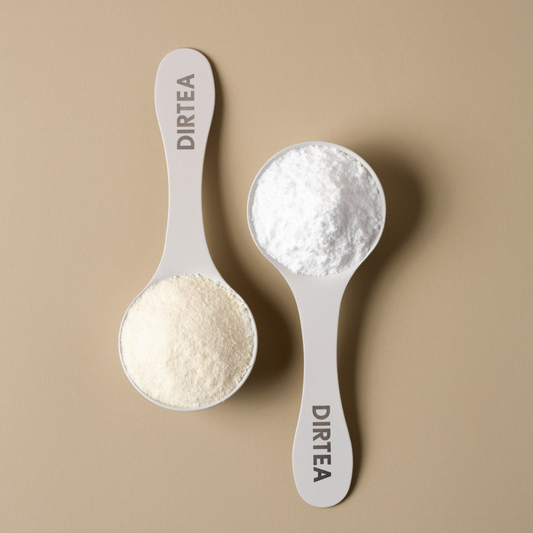
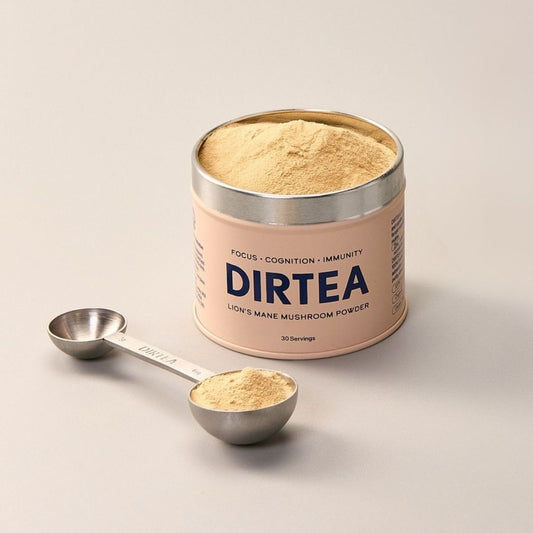
Your DIRTEA Lion’s Mane Focus Powder might sit next to the kettle. Your gummies might stay near breakfast. DIRTEA Creatine might sit beside your shaker and DIRTEA Collagen next to your morning drink.
Instead of relying entirely on memory, your surroundings become part of the reminder.
4. Reduce Decisions
Every extra decision adds friction.
When should I exercise? When should I take my supplements? Should I do it before or after breakfast?
The more decisions a habit requires, the easier it becomes to postpone.
Instead, choose a regular moment.
If Creatine is part of your routine, you might add it to a drink you already make each day. The same principle can apply to Collagen or your daily supplements.
Rather than treating wellness as another task on your to-do list, connect it to something already happening.
Do not create more things to remember. Connect new habits to things you already remember.
5. Create a Minimum Version
Many routines are designed for our most motivated days.
A 60-minute workout feels realistic when you have plenty of time. Then November arrives, it is dark at the end of the working day and suddenly an hour feels impossible.
Instead of abandoning the habit, create a minimum version.
Your usual workout might be 45 minutes. Your minimum might be ten.
Your ideal morning routine might involve a long walk, breakfast and journalling. Your minimum could be five minutes outside followed by your usual morning drink.
The minimum version keeps the behaviour present without demanding that every day looks the same.
You can always do more.
The important thing is not allowing “I can’t do everything today” to automatically become “I’ll do nothing.”
6. Let Your Routine Change With the Season
Consistency does not mean doing exactly the same thing 365 days a year.
Your summer routine might involve a 30-minute walk before work. In winter, that might become ten minutes outside followed by movement indoors.
Your summer evening workout might happen at 8pm while it is still light. During the darker months, moving earlier may fit your routine better.
The details can change without abandoning the underlying habit.
Ask yourself:
What am I actually trying to maintain?
If the goal is regular movement, the exact workout can change.
If the goal is a consistent morning ritual, the details can evolve.
If the goal is remembering your supplements, focus on creating a reliable cue that works with your lifestyle.
A flexible routine is not an inconsistent one. It is a routine designed to survive real life.
7. Stop Treating a Missed Day as Failure
You will miss days.
Travel happens. Work gets busy. You sleep through your alarm. Sometimes you simply do not feel like doing what you planned.
That does not erase the habit.
Research into habit formation found that missing one opportunity did not materially affect the process of developing automaticity.
What matters is what happens next.
Instead of thinking:
“I’ve ruined the routine.”
Ask:
“What is my next opportunity to return to it?”
The ability to restart may be more useful than trying to maintain a perfect streak.
Work With Your Environment, Not Against It
When your habits start slipping as the seasons change, look at what has changed around them.
Is your morning darker? Are you spending less time outside? Has your workout suddenly moved into the dark? Has something that felt easy in summer become inconvenient?
Then adjust the environment.
Create clearer cues. Make important behaviours visible. Reduce unnecessary decisions. Build a minimum version for difficult days. Attach new behaviours to rituals you already repeat.
The strongest routine is not necessarily the most elaborate one.
It is the one you can keep coming back to.
Final Thoughts
Light changes. Schedules change. Your routine can change with them.
Instead of building the perfect routine for your most motivated day of the year, build one that
still works on a dark Tuesday morning in January.
Keep it visible. Keep it simple. Connect it to something you already do.
And when you miss a day, begin again.
Because habits are not built by being perfect. They are built by returning.
FAQs
Why do my habits get worse in winter?
Darker mornings, earlier sunsets and changes in how much time you spend outdoors can alter
the environmental cues surrounding your usual routine. Light is also an important signal for
the body’s circadian timing system.
Does it really take 21 days to form a habit?
Not necessarily. Research into real-world habit formation found substantial variation between
individuals, with participants taking between 18 and 254 days to reach 95% of their eventual
automaticity.
What is the best way to make a habit stick?
Give it a reliable cue. Connecting a behaviour to something you already do — such as taking
supplements after breakfast or going for a walk after your morning drink — can make it
easier to remember and repeat.
Does missing one day ruin a habit?
No. Research has found that missing one opportunity did not materially affect the habit-
formation process. Focus on returning to the behaviour rather than maintaining a perfect
streak.
How can I maintain healthy habits during winter?
Adapt your routine to the season. You could exercise earlier, create shorter versions of habits
for busy days, keep important items visible and attach new behaviours to existing daily
rituals.
How can I remember to take supplements every day?
Connect them to a behaviour that already happens consistently, such as breakfast or making
your morning drink, and keep them somewhere visible near that cue.
References
Blume, C., Garbazza, C., & Spitschan, M. (2019). Effects of light on human circadian
rhythms, sleep and mood. Somnologie, 23(3), 147–156. https://doi.org/10.1007/s11818-019-
00215-x
Lally, P., van Jaarsveld, C. H. M., Potts, H. W. W., & Wardle, J. (2010). How are habits
formed: Modelling habit formation in the real world. European Journal of Social Psychology,
40(6), 998–1009. https://doi.org/10.1002/ejsp.674